Three Hours and Twenty-Eight Dollars: The Desperate Invention That Secretly Holds Your Life Together
The Debt That Changed Everything
Walter Hunt was broke. It was April 1849, and the New York inventor owed his friend twenty-eight dollars—roughly $1,000 in today's money. His creditor was getting impatient, and Hunt needed cash fast. So he did what any desperate inventor would do: he grabbed a piece of brass wire and started twisting.
 Photo: New York, via justinkelefas.com
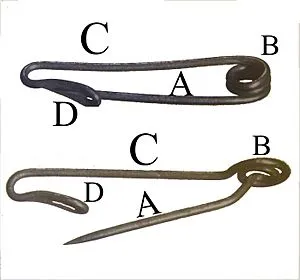 Photo: Walter Hunt, via kids.kiddle.co
Three hours later, Hunt had bent that wire into something the world had never seen before. It was simple, elegant, and solved a problem that had plagued humanity since people first started wearing clothes. He called it a "dress pin," but we know it better as the safety pin.
What Hunt couldn't have known as he frantically worked to pay off his debt was that he'd just created one of fashion's most enduring and versatile tools. That twisted piece of wire would go on to hold together Victorian corsets, punk rock rebellion, and everything in between.
A Problem Hiding in Plain Sight
Before Hunt's moment of desperation, people had been struggling with the same basic problem for centuries: how to fasten fabric safely. Straight pins worked, but they had a nasty habit of coming loose and stabbing whoever wore them. Buttons required buttonholes. Ties took time.
The genius of Hunt's design wasn't just its simplicity—it was its safety. By creating a spring mechanism that held the sharp point inside a protective clasp, he'd solved the stabbing problem that made straight pins so dangerous. The pin could hold fabric securely while keeping its point safely contained.
But Hunt was so focused on his immediate financial crisis that he made one of history's biggest business blunders. Desperate for quick cash, he sold his patent rights for just $400 to pay off his debt and pocket some extra money. He had no idea he'd just given away rights to a billion-dollar invention.
From Practical Tool to Cultural Symbol
The safety pin's first job was purely functional. Victorian women used them to secure the complex undergarments that defined 19th-century fashion—corsets, bustles, and layers of petticoats that required dozens of fastening points. The safety pin was perfect for quick adjustments and emergency repairs.
By the early 1900s, safety pins had become essential for new mothers. The invention of disposable diapers was still decades away, so parents relied on cloth diapers secured with safety pins. An entire generation of American children grew up with the distinctive sound of safety pins opening and closing as part of their daily routine.
But the safety pin's most surprising transformation came in the 1970s, when punk rockers in London and New York adopted it as a symbol of rebellion. What had been a tool of domestic practicality suddenly became a statement of anti-establishment defiance. Punks pierced their clothing—and themselves—with oversized safety pins, turning Hunt's innocent invention into a badge of cultural resistance.
The Invisible Revolution
Today, safety pins are everywhere and nowhere. They're in every American junk drawer, sewing kit, and office supply closet, yet they're so common we barely notice them. They hold together temporary hems, replace broken zippers, and provide emergency clothing fixes. They secure race numbers to marathon shirts and hold name tags at conferences.
The global safety pin market is now worth hundreds of millions of dollars annually. Billions of safety pins are manufactured each year, in sizes ranging from tiny versions for delicate fabrics to heavy-duty pins for industrial use. Hunt's basic design has remained virtually unchanged for more than 170 years—a testament to its simple perfection.
Beyond Fashion
The safety pin has transcended its original purpose in ways Hunt never imagined. During World War II, resistance fighters used safety pins as secret symbols of solidarity. In recent years, safety pins have become symbols of support for marginalized communities, worn as subtle signs of allyship and protection.
The pin has also found unexpected uses in fields far from fashion. Surgeons use specialized safety pins for certain medical procedures. Engineers use them for quick prototyping. Artists incorporate them into sculptures and installations.
The Patent That Got Away
Perhaps the most remarkable part of the safety pin story is what Walter Hunt lost by selling his patent so quickly. If he had held onto his rights, his family could have earned millions from royalties over the years. Instead, the patent holders who bought his design for $400 went on to build fortunes from his three hours of desperate innovation.
Hunt continued inventing until his death in 1859, creating everything from fountain pens to ice plows. But none of his other inventions achieved the universal adoption of that piece of twisted wire he created to pay off a twenty-eight-dollar debt.
The next time you reach for a safety pin to make a quick clothing repair or secure a loose strap, remember Walter Hunt's frantic afternoon in 1849. In just three hours, a broke inventor created a tool so perfect that we're still using his exact design more than 170 years later. Sometimes the most revolutionary inventions come not from grand visions, but from simple desperation and the need to solve an immediate problem.