The T-Shirt Spent 50 Years as Underwear — Then Two Actors Blew That Up Forever
The T-Shirt Spent 50 Years as Underwear — Then Two Actors Blew That Up Forever
The T-shirt is, by almost any measure, the most democratic garment in American history. Everybody has them. Everybody wears them. They come in every color, carry every message, and show up in every context from the gym to the gallery opening. A plain white T-shirt is so basic it barely counts as a clothing choice anymore.
Which makes it genuinely strange to consider that for the first half of the twentieth century, wearing one in public would have gotten you stared at — not because you looked stylish, but because you were essentially walking around in your underwear. Because that's exactly what it was.
How the T-Shirt Started Its Life
The crew-neck cotton undershirt has been around in various forms since the mid-1800s, but the version that became the modern T-shirt was standardized by the U.S. Navy around the turn of the twentieth century. The Navy needed a lightweight, easy-to-launder undergarment that sailors could wear beneath their uniforms in warm climates. The solution was a simple short-sleeved, crew-neck cotton shirt — designed to be invisible under a uniform jacket, to absorb sweat, and to hold up to repeated washing in rough conditions.
The Army adopted a similar design around the time of World War I. By the 1920s, the cotton undershirt was standard military-issue across multiple branches of the service. It was listed in supply manifests right alongside socks and long underwear, because that's exactly what it was: a foundational layer meant to be covered by something else.
For civilians, the undershirt market was dominated by companies like Fruit of the Loom and Hanes, who sold them in multipacks as basic undergarments. Wearing one as outerwear simply wasn't something people did — not because there was a law against it, but because the social understanding was clear. An undershirt was underwear. Wearing it alone in public was the equivalent of forgetting to finish getting dressed.
What the War Did to American Clothing
World War II scrambled a lot of things, and American dress codes were among them.
Millions of young men spent years in military service wearing T-shirts as a matter of daily routine — in training camps, in tropical postings, on naval vessels, in mess halls, in barracks. The garment became deeply familiar. For many servicemen, it was the most comfortable thing they owned. In hot climates especially, T-shirts were worn as the primary top layer simply because wearing a full uniform in ninety-degree heat was miserable and commanders made practical allowances.
War correspondents and photographers documented all of this. Images of soldiers and sailors working, resting, and training in their white undershirts circulated widely on the home front. The T-shirt started appearing in newspapers and magazines in contexts that were unambiguously heroic and masculine — guys building things, fixing engines, doing the hard work of the war. The garment was absorbing new associations in real time.
When veterans came home in 1945 and 1946, they brought those associations with them. Men who had spent years wearing T-shirts in the company of other men, in circumstances that felt important and physical and real, weren't inclined to suddenly treat the garment as something shameful. They wore them in the yard. They wore them to the gas station. They wore them doing the kind of physical labor that the postwar suburban boom demanded in enormous quantities.
The old rule — undershirts stay under things — started quietly fraying.
Then Hollywood Got Involved
The cultural tipping point, if you had to pick one, was 1951.
That's when Marlon Brando appeared on Broadway in A Streetcar Named Desire wearing a plain white T-shirt that fit close to his body and communicated something that the American theater-going public had not quite encountered before: raw, physical masculinity presented without apology. The T-shirt wasn't incidental to the character of Stanley Kowalski — it was central. It signaled working-class authenticity, physicality, barely contained energy. The costume did half the acting.
When the film adaptation came out in 1951 with Brando reprising the role, the image reached an exponentially larger audience. The white T-shirt stopped being underwear in the cultural imagination and started being something else: a statement. A type. A look.
James Dean reinforced it. His appearance in Rebel Without a Cause in 1955 — jeans, white T-shirt, red jacket — created one of the most replicated images in American pop culture history. Dean's T-shirt wasn't just clothing; it was an attitude. It said young, restless, not particularly interested in your dress codes.
That framing was enormously appealing to the postwar generation coming of age in the mid-1950s. Teenagers who had grown up watching their fathers come home from the war, who had absorbed the imagery of men doing serious things in simple cotton shirts, now had two of the most compelling actors in Hollywood telling them that the T-shirt was cool. The garment's status flipped almost overnight.
From Underwear to Icon
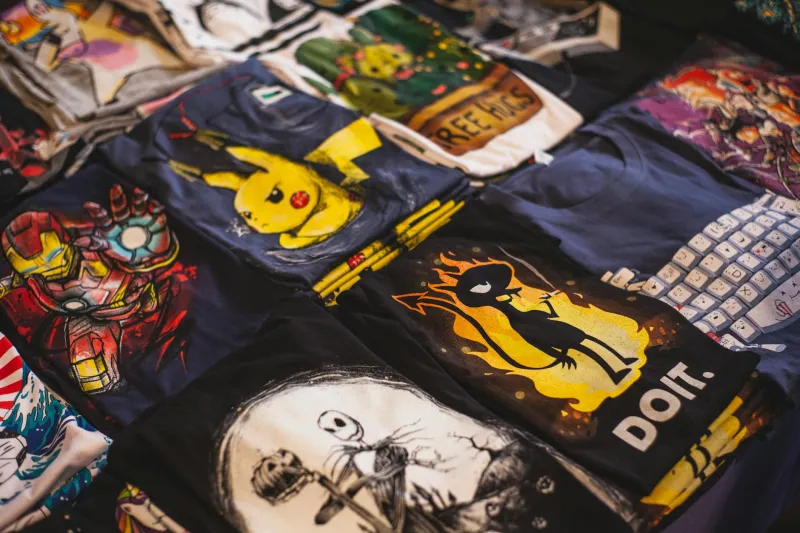
By the late 1950s, T-shirts were being sold as outerwear without any particular controversy. By the 1960s, they had become a canvas — for band logos, political slogans, university names, and personal expression of every kind. The tie-dye T-shirts of the counterculture, the concert tees of the 1970s, the logo shirts of the 1980s: each era added a new layer of meaning to a garment that had started out as a piece of military-issue cotton meant to go unseen.
The whole transformation — from Navy undershirt to global cultural icon — took about sixty years. And the most dramatic phase of it happened in less than a decade, driven by a combination of wartime habit, returning veterans, and two actors who understood, consciously or not, that what you wear communicates something before you open your mouth.
The T-shirt didn't change. The story attached to it did. And once that story changed, there was no going back.