Before the Credit Card, There Was a Metal Plate in a Velvet Pouch — And It Changed How Americans Think About Money

Somewhere in a box of old family papers, or tucked into the back of a vintage leather wallet at an estate sale, you might find one. It looks almost like a military dog tag — a small, rectangular piece of embossed metal, stamped with a name, an address, and a store name. Sometimes it still comes with its original velvet or leather pouch.
This is a charge plate. And before the Visa card, before the Mastercard, before American Express, this small piece of metal was how a certain kind of American shopped — and how an entire culture learned to equate spending on credit with social status.
The charge plate didn't invent consumer debt. But it invented the feeling of consumer debt. And that feeling, it turns out, was worth more than anyone realized.
Department Stores and the Problem of the Loyal Customer
To understand the charge plate, you need to understand what American department stores were trying to solve in the early 20th century.
By the 1920s and 1930s, department stores like Marshall Field's in Chicago, Filene's in Boston, and Wanamaker's in Philadelphia had become civic institutions. They were destinations — places where middle- and upper-class Americans spent entire days, eating in the restaurant, browsing multiple floors, attending demonstrations and events. The experience was designed to be total.
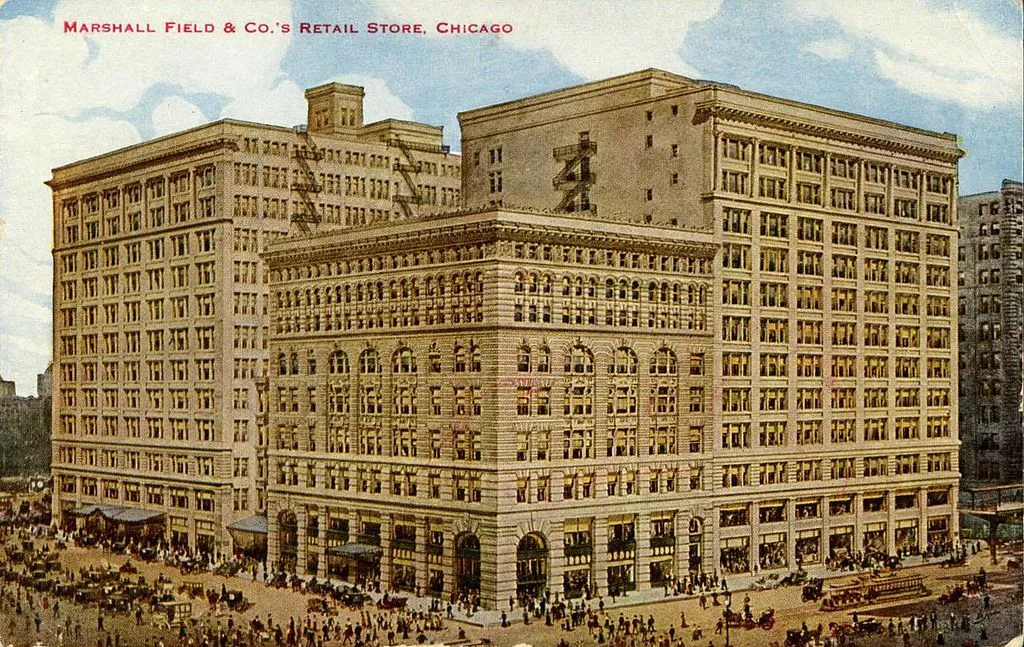 Photo: Marshall Field's, via i.pinimg.com
Stores had long maintained informal credit arrangements with their best customers. A trusted shopper might tell a clerk to "put it on the account," and the clerk — who recognized the customer — would do exactly that. The bill would arrive at the end of the month.
This system worked fine in small stores where clerks knew everyone. It fell apart in large department stores with dozens of staff and hundreds of regular customers. Fraud was a genuine problem. So was the awkward moment when a clerk didn't recognize a customer who claimed to have an account.
Stores needed a system. They needed something a customer could carry.
The Charge Plate Arrives
The Charga-Plate — the trademarked version that became standard — was developed in the early 1930s and saw widespread adoption through the late 1930s and 1940s. The design borrowed from military identification technology: an embossed aluminum or steel plate that could be pressed against a carbon paper receipt to transfer the customer's information automatically.
The mechanics were straightforward. A customer presented their plate at the counter. The clerk placed it in a small imprinting device, pressed, and the customer's name and account number transferred cleanly to the receipt. No handwriting required. No awkward verification conversations.
But the design of the charge plate was never purely functional.
The plates were issued selectively. Not every customer qualified. You had to apply, demonstrate creditworthiness, and be approved — a process that carried its own social weight. Receiving your charge plate in the mail, often presented in a small velvet or leather pouch, was a signal. It meant the store had evaluated you and found you trustworthy. It meant you were, in the language of the era, "a good customer."
That distinction mattered enormously in Depression-era and postwar America, where financial stability was anything but guaranteed.
The Psychology of the Plate
This is where the charge plate story gets genuinely interesting, because what these stores were selling wasn't just convenient payment. They were selling belonging.
Holding a Marshall Field's charge plate meant you were the kind of person who shopped at Marshall Field's — regularly enough, and reliably enough, that the store had extended you formal credit. The plate was a credential. It identified you as a member of a particular consumer class.
The velvet pouch wasn't accidental. It was a deliberate design choice that transformed a functional object into something closer to a gift — something to be stored carefully and presented with a certain confidence. Women who carried charge plates in the 1940s and 1950s often describe the experience as feeling like being known by the store, recognized as a valued customer rather than an anonymous shopper.
Stores cultivated this feeling intentionally. Some sent Christmas cards to charge plate holders. Others offered early access to sales or special events. The charge plate holder was a VIP before the term existed.
What this did, over time, was attach a sense of respectability to the act of buying on credit. In earlier American culture, debt carried significant moral stigma. You paid cash, or you did without. The charge plate began dismantling that stigma by reframing credit as a privilege extended to trustworthy people — not a burden carried by people who couldn't manage their money.
From Store Plate to Universal Card
The Diners Club card appeared in 1950, followed by American Express in 1958 and BankAmericard — the precursor to Visa — in 1958 as well. These universal cards extended the charge plate concept beyond individual stores, creating a single credential that worked across multiple merchants.
The psychological infrastructure was already in place. Americans had spent two decades learning to associate a small piece of embossed metal with trustworthiness, status, and belonging. The universal credit card didn't have to teach people a new behavior. It just had to expand the one they already had.
The shift from charge plate to credit card also changed the economics in ways that weren't immediately visible to consumers. Department store charge plates were typically paid in full monthly — they were convenience tools, not revolving debt instruments. The modern credit card introduced the concept of the minimum payment, which transformed credit from a short-term convenience into a long-term financial relationship.
By the time that shift happened, the cultural work was already done. Americans had already learned to feel good about spending on credit.
The Small Object That Built a Big Economy
The charge plate never made headlines. It didn't have an inventor with a famous origin story or a dramatic moment of discovery. It was a practical solution to a retail logistics problem, designed by people whose names are largely forgotten.
But its cultural impact is hard to overstate. The modern American consumer economy — built on credit cards, revolving debt, and the normalization of buying things before you've fully paid for them — rests on a psychological foundation that was quietly laid on the floors of department stores in the 1930s and 1940s.
The velvet pouch was the tell. Nobody puts a functional tool in a velvet pouch. They put something precious there, something that carries meaning beyond its material value.
The stores understood exactly what they were doing. They were selling the feeling of creditworthiness. And Americans, it turned out, were very willing to buy it.