Nobody Wanted It for Three Years — Then IBM Accidentally Made Bubble Wrap Famous
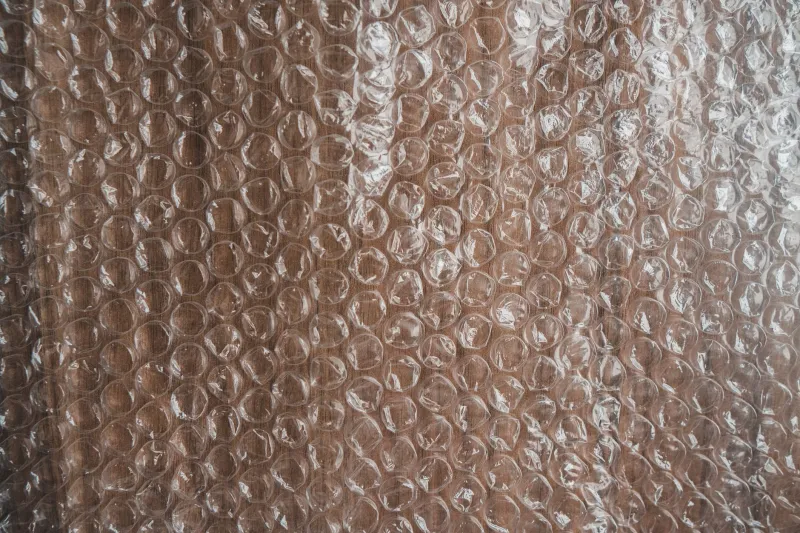
If you've ever torn open a package just to find yourself mindlessly popping the plastic cushioning inside, you've participated in one of the great accidental traditions of the modern world. Bubble wrap is everywhere — lining boxes, protecting fragile shipments, and apparently doing something measurable for your stress levels. But the strange truth is that the stuff was never designed to protect anything at all.
It was supposed to go on your walls.
A Shower Curtain, a Tablecloth, and a Very Bad Idea
In 1957, two engineers named Alfred Fielding and Marc Chavannes were working in a garage in Hawthorne, New Jersey, trying to build something the home décor market would actually want. Their concept: a three-dimensional, textured wallpaper that would give midcentury American living rooms a modern, tactile feel.
 Photo: Hawthorne, New Jersey, via www.simflight.com
 Photo: Marc Chavannes, via pbs.twimg.com
 Photo: Alfred Fielding, via img.mako.co.il
Their method was straightforward enough. They sealed two shower curtains together, trapping small pockets of air between the layers. The result was a soft, bubbly surface that did, technically, have texture. What it didn't have was any real appeal as a wall covering. The material looked unusual, it didn't hold paint particularly well, and nobody who saw it immediately thought, yes, that's what my den needs.
Fielding and Chavannes had a product. They just had absolutely no idea what it was for.
They spent the next three years trying to figure that out. At one point, they pitched the material as greenhouse insulation — the trapped air pockets could theoretically hold heat. It didn't catch on. They tried marketing it as cushioning for car dashboards. That went nowhere too. The material sat in a kind of commercial limbo, technically impressive, practically useless, quietly waiting for someone to find a reason it should exist.
The IBM Problem That Changed Everything
In 1960, IBM was preparing to ship its new 1401 computer — a machine about the size of a refrigerator that represented a serious leap forward in business computing. The problem wasn't the technology. It was the packaging.
Computers at that scale were expensive, delicate, and extremely vulnerable to the bumps and vibrations of long-distance freight. The standard packing materials of the era — crumpled newspaper, wood shavings, paper padding — weren't reliable enough. IBM needed something that could absorb shock consistently, wrap around irregular shapes, and hold up across a cross-country shipment without compressing flat.
Fielding and Chavannes had been running their company, Sealed Air Corporation, for a couple of years by then, still looking for a market. When they heard about IBM's packaging challenge, they made their pitch. The bubbly plastic material they'd invented as wallpaper turned out to be exactly what a shipping department needed. The air pockets distributed pressure evenly. The material was lightweight. It could be cut to size and wrapped around almost anything.
IBM signed on, and Sealed Air had its first real customer.
Within a few years, the product had a name — Bubble Wrap, trademarked by Sealed Air — and a clear commercial identity. Electronics manufacturers followed IBM's lead. Then came fragile goods of every kind: glassware, ceramics, medical equipment, art. By the 1970s, Bubble Wrap had become the default protective packaging for anything that couldn't afford to arrive broken.
The Psychology of the Pop
Here's the part that even Fielding and Chavannes probably didn't anticipate: people don't just use bubble wrap. They play with it.
The compulsive urge to pop the little air pockets turns out to be well-documented in psychology. Research has found that repetitive tactile actions — the kind that produce a small, predictable sensory reward — can reduce cortisol levels and lower feelings of anxiety. The pop itself is satisfying in a deeply physical way: there's resistance, then release, then a small sound. It's a complete little loop of cause and effect that the brain apparently finds genuinely calming.
A 1992 study at Hobart and William Smith Colleges in New York found that subjects who popped bubble wrap reported feeling more alert and less stressed afterward. Therapists have noted it as a low-stakes fidget tool. There's even a recognized annual event — Bubble Wrap Appreciation Day, observed on the last Monday of January — that has been running since 2001.
Sealed Air has leaned into this. For a while, they sold a virtual bubble wrap app. They've released special limited-edition sheets. The company has turned what started as a packaging quirk into a piece of the brand's identity.
From Accident to Industry
Sealed Air Corporation, the company Fielding and Chavannes built on the back of their failed wallpaper experiment, now generates billions of dollars in annual revenue. Bubble Wrap — and its various successors, including inflatable air pillows and foam-backed versions — accounts for a significant chunk of the global protective packaging market.
The original product has evolved considerably. Sealed Air introduced iBubble Wrap in 2015, a version that ships flat and gets inflated on-site, reducing storage costs for large-scale shippers. Amazon has developed its own proprietary air cushion systems. But the basic principle — trapped air absorbing shock — is the same one Fielding and Chavannes stumbled onto in a New Jersey garage while trying to sell textured wallpaper.
That's the version of the story worth holding onto. Two engineers with a bad product idea spent three years pitching it to the wrong industries before the right problem came along. The invention didn't change. The application did.
Next time you pop a sheet of it without thinking, you're technically participating in the legacy of a home décor failure that accidentally became one of the most widely used materials in global commerce. And apparently, it's good for your stress levels. So there's that.