That Dressing Room Mirror Isn't Showing You the Truth — And Retailers Know It
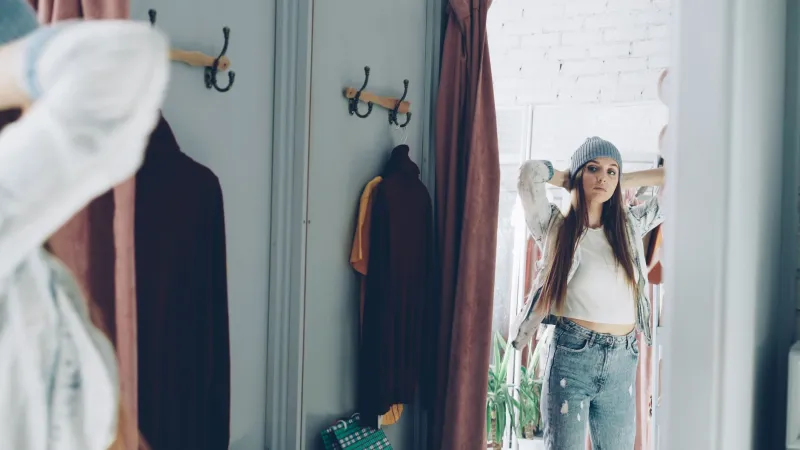
That Dressing Room Mirror Isn't Showing You the Truth — And Retailers Know It
You've had the experience. You try something on in a store dressing room, catch your reflection, and think — that actually looks pretty good. You buy it. You get home, try it on again in your bathroom mirror, and something has shifted. The fit seems different. The color seems off. You look, somehow, less like yourself than you did twenty minutes ago in the store.
You didn't imagine it. The mirror in the dressing room was almost certainly not showing you an accurate reflection. And the retailer put it there knowing exactly what it would do.
The Fitting Room as Sales Environment
The modern retail fitting room has existed in roughly its current form since the late 19th century, when department stores began providing private spaces for customers to try on garments before purchasing. Early fitting rooms were utilitarian — a curtained alcove, a hook on the wall, a mirror if you were lucky.
But as retail competition intensified through the 20th century, fitting rooms became something more deliberate. Retailers began to understand that the moment a customer tries on a garment is the most psychologically decisive moment in the entire shopping experience. Everything that happens in that small room — the lighting, the mirror, the spatial layout, even the temperature — influences whether the customer walks out with a purchase.
Studies conducted by retail consultants from the 1970s onward consistently found that customers who entered a fitting room were dramatically more likely to buy than customers who browsed without trying anything on. The fitting room wasn't just a convenience. It was the closing argument in a sale. And like any good closing argument, it could be optimized.
The Mirror Angle
Here's the part that surprises most people: a mirror doesn't have to be curved or specially coated to make you look slimmer. It just has to be tilted.
A mirror angled very slightly backward — top tilting away from you by just a few degrees — creates a reflection that appears to lengthen the body vertically and compress it horizontally. The effect is subtle enough that most people don't consciously register it, but measurable enough that it changes how a garment appears to fit. Retail designers have known this for decades.
The optimal tilt varies slightly depending on the height of the average customer and the distance from the mirror, but the principle is consistent: a mirror that leans slightly away from you will make you look taller and narrower than one that stands perfectly perpendicular. Many fitting room mirrors are installed with this tilt deliberately built in.
Some retailers go further. Mirrors with a very slight convex curve — barely perceptible to the naked eye — can create a similar elongating effect across the full width of the reflection. These are more expensive to produce but more consistent in their effect regardless of where the customer stands.
The Light That Changes Everything
If the mirror angle is the subtle trick, lighting is the heavy lifting.
Fitting room lighting is one of the most studied variables in retail design, and the findings are surprisingly specific. Fluorescent overhead lighting — the kind used in many budget stores and grocery stores — casts a harsh, downward light that emphasizes shadows under the eyes, below the chin, and in the contours of the body. It makes skin look flat and slightly greenish. It is, in retail terms, a disaster.
The lighting that makes people look and feel best in fitting rooms is warm-toned (typically around 2700 to 3000 Kelvin on the color temperature scale) and positioned at roughly face height, slightly in front of the customer rather than directly overhead. This mimics the quality of candlelight or early evening sunlight — the kind of light that has historically been considered the most flattering for human skin tones.
High-end retailers figured this out early. Walk into a fitting room at a well-funded clothing brand and you'll often notice the light feels different from the rest of the store — softer, warmer, more even. That's not accidental ambiance. It's engineered to make your skin look better, to reduce the appearance of shadows and imperfections, and to make the garment's colors appear richer and more vibrant.
The difference between a well-lit fitting room and a poorly lit one can genuinely change whether a customer purchases. One retail consultancy study found that improving fitting room lighting alone increased conversion rates — the percentage of fitting room visitors who made a purchase — by measurable double digits in test stores.
Color on the Walls
The mirror and the lighting get most of the attention, but the walls matter too.
Fitting room wall color affects how customers perceive both themselves and the garment they're trying on. Warm neutral tones — soft whites, warm creams, pale blush — reflect warm light back onto the customer, reinforcing the flattering effect of warm-toned bulbs. Cooler colors can undermine that effect. Dark colors make small spaces feel smaller, which increases anxiety. Bright whites can create harsh contrast.
Many fashion retailers use a warm off-white or a soft neutral as a default because it's versatile across different garment colors while still contributing to the overall flattering environment. The goal is a space where the customer feels comfortable enough to spend time, and confident enough to say yes.
Why This Matters Beyond the Dressing Room
None of this is exactly a secret. Retail designers write about it openly in trade publications. Lighting companies market their products specifically to fitting room applications. Mirror manufacturers advertise tilt specifications to retail buyers.
But most shoppers have no idea it's happening, which is precisely why it works.
The fitting room mirror isn't lying to you in a sinister sense — it's not showing you something that doesn't exist. The clothes genuinely do look better under good lighting. You genuinely do look better in warm light than in fluorescent overhead glare. The mirror angle isn't creating an illusion so much as presenting a version of reality that happens to be commercially convenient.
The more useful thing to know is that your bathroom mirror at home is probably showing you something closer to neutral reality — and that the gap between the two isn't a flaw in your judgment. It's a gap that was carefully engineered by people who understand retail psychology better than most of us understand ourselves.
Next time you feel that small surge of confidence in a fitting room, it's worth pausing for half a second to ask: is this the clothes, or is this the room? The answer is almost always both — and the room has been working on this a lot longer than you have.