The Swimsuit Was Almost Illegal: America's Long, Uncomfortable War Over What to Wear in the Water

Photo: Steve Shook from Moscow, Idaho, USA, CC BY 2.0, via Wikimedia Commons
The Swimsuit Was Almost Illegal: America's Long, Uncomfortable War Over What to Wear in the Water
Imagine showing up to the beach and having a city employee walk over with a tape measure. Not to check your parking permit. To measure your legs.
This was a real job in early 20th-century America. Cities like Chicago and Washington, D.C. employed "beach police" — sometimes called "bathing suit inspectors" — whose responsibility was enforcing decency ordinances that governed exactly how much skin a woman could expose near water. Violations could result in fines, forced removal from the beach, or arrest.
The swimsuit we know today — lightweight, form-fitting, designed to actually move in water — didn't exist yet. What existed was something considerably more complicated, considerably heavier, and considerably worse at the one thing a swimsuit is supposed to do.
The Original Swimsuit Was Designed to Keep You Covered, Not Afloat
In the 19th century, "bathing" at the beach wasn't really about swimming. It was a health ritual — a controlled dip in salt water that was believed to have restorative properties. Actual swimming was considered vulgar, athletic, and vaguely dangerous. You waded in, you soaked, you waded out.
The clothing designed for this activity reflected its purpose. Women wore full-length wool dresses with bloomers underneath, often weighted at the hem to prevent the fabric from floating up. Some designs included attached belts with rings so that a rope could be attached, allowing attendants to pull a woman back to shore if she drifted too far — which, given the weight of the outfit, was a genuine risk.
The "bathing machine" was a common fixture at Victorian beaches on both sides of the Atlantic. It was essentially a changing room on wheels — a wooden hut that could be pulled by horses into the surf so that a woman could descend directly into the water without being seen walking across the beach in her bathing costume. Privacy was paramount. The idea of a woman's body being observed in a wet garment was considered deeply improper.
This is the world American beach culture inherited as it developed in the early 1900s.
When Annette Kellerman Got Arrested for Wearing a Swimsuit
In 1907, an Australian competitive swimmer named Annette Kellerman walked onto Revere Beach in Massachusetts wearing a one-piece swimsuit that covered her from neck to ankle but was fitted enough to show the shape of her body.
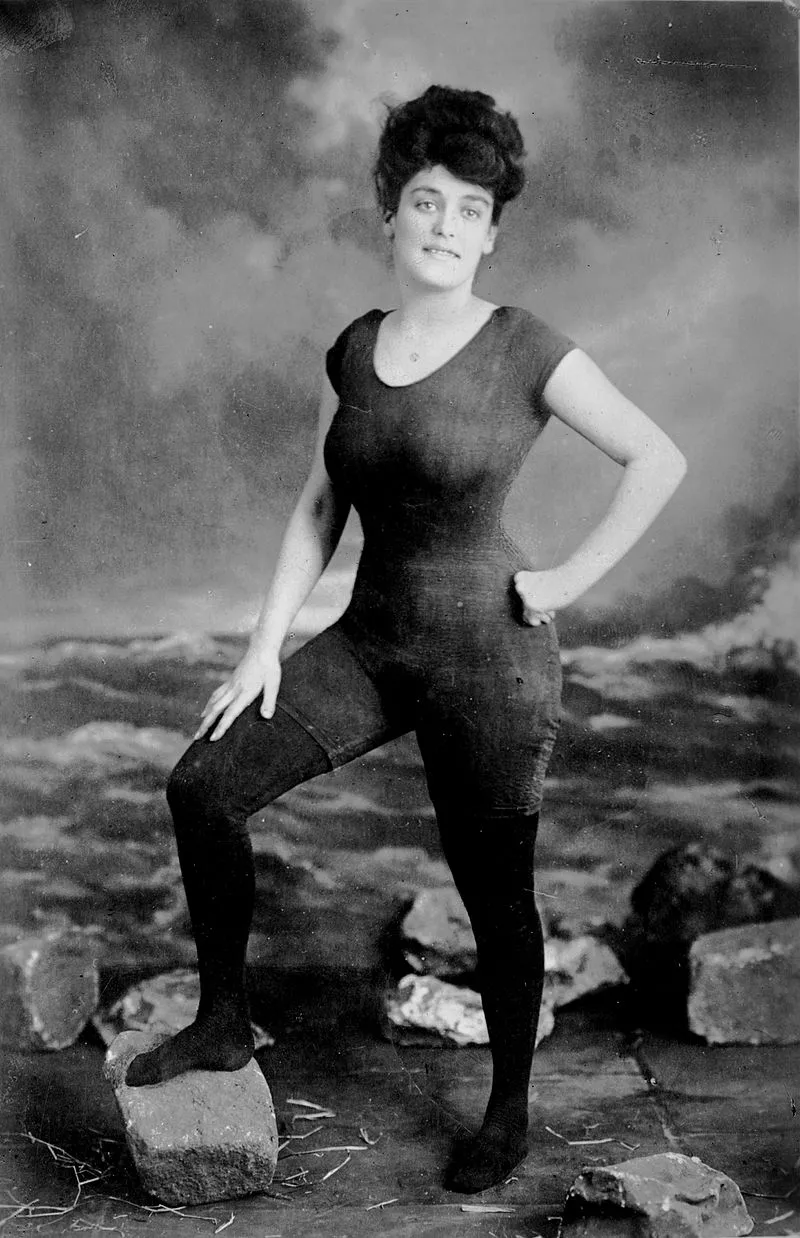 Photo: Annette Kellerman, via www.thevintagenews.com
 Photo: Revere Beach, via thumbs.dreamstime.com
She was arrested.
The charge was indecency. The suit, by later standards, was extraordinarily modest. But in 1907, the fact that it followed the contours of a woman's figure was enough to constitute a public offense.
Kellerman fought back — not in court, but in public. She was a skilled self-promoter, and she used the arrest to generate press coverage and debate about the absurdity of requiring women to swim in garments that could drown them. She eventually won the argument, at least partially. The one-piece fitted swimsuit gradually became acceptable, though the process took years and played out differently in different cities.
The tape-measure beach police didn't disappear overnight. As late as the 1920s, some American municipalities were still actively enforcing hemline ordinances at public beaches.
The Roaring Twenties and the Rise of the Practical Suit
The 1920s changed American beach culture significantly. Swimming became a genuine recreational sport rather than a health ritual. Women like Gertrude Ederle — who swam the English Channel in 1926 — demonstrated publicly that athletic performance in the water required athletic clothing.
Knitwear technology improved. Lighter, more elastic fabrics replaced heavy wool. The silhouette shortened and narrowed. By the 1930s, the two-piece swimsuit — with a bare midriff — had appeared, though it remained controversial in many parts of the country.
Hollywood played its usual amplifying role. Studios photographed actresses in swimsuits as a matter of routine, and the images circulated nationally, normalizing progressively less coverage as the decade went on.
But the most dramatic moment was still coming.
1946: The Year a Designer Bet Everything on Four Triangles
World War II had imposed strict fabric rationing on American and European clothing manufacturers. Swimsuits were required to use less material — a government mandate, not a fashion choice. The result was that American women spent the war years in suits that were already considerably more revealing than anything that had existed a decade earlier.
When French designer Louis Réard introduced the bikini in Paris on July 5, 1946 — just four days after the United States conducted a nuclear test at Bikini Atoll — he named it deliberately for the explosion he expected it to cause.
He wasn't wrong. Réard couldn't find a professional model willing to wear it. He ultimately hired a 19-year-old nude dancer named Micheline Bernardini. The design — two small pieces of printed fabric connected by string — was so minimal that Réard marketed it as "smaller than the world's smallest bathing suit."
It caused an international scandal. Several countries banned it. American retailers largely refused to stock it through the late 1940s and into the 1950s.
What changed the equation, predictably, was Hollywood. When Brigitte Bardot wore a bikini at the Cannes Film Festival in 1953, the conversation shifted almost overnight. By the early 1960s, the bikini was appearing in American films and on American beaches, still controversial in some communities but no longer illegal.
 Photo: Brigitte Bardot, via pictures.abebooks.com
A Piece of Cloth That Became a Political Object
What's remarkable about the swimsuit's history is how much cultural weight accumulated around a garment whose only practical purpose is to get wet.
Every shift in swimsuit design — from the weighted wool dress to the fitted one-piece to the two-piece to the bikini — generated genuine public debate about morality, gender, bodily autonomy, and social norms. The tape-measure beach police weren't an anomaly. They were a symptom of how seriously Americans took the question of what a woman's body was allowed to look like in public.
That argument has never fully ended. It's just moved to different venues.