How a Piece of Football Padding Became the Most Politically Charged Seam in Women's Fashion
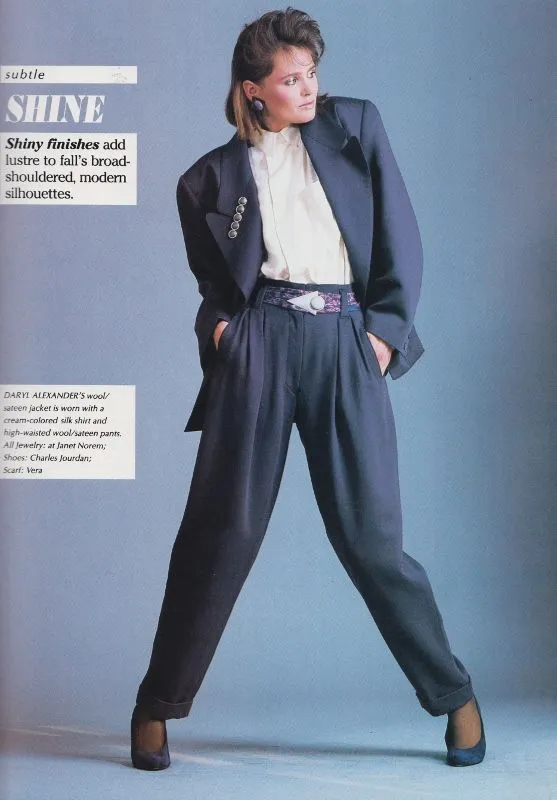
Photo: 1980s power suit women shoulder pads business fashion, via i.pinimg.com
If you want to understand why shoulder pads keep coming back, you have to start on a muddy football field in the 1870s. Not in a design studio. Not in Paris. On a field where men were getting badly hurt and someone needed to figure out how to stop that from happening.
What emerged from that problem eventually reshaped how an entire culture thought about women, work, and what it looks like to hold power.
The Field Where It Started
American football in the 1870s was a brutal and largely unprotected sport. Players wore little more than canvas pants and wool jerseys, and injuries — particularly to the shoulders, which absorbed enormous impact during tackles — were common and often serious.
The first documented use of shoulder protection came around 1877, when a Princeton player reportedly began wearing leather pads strapped to his shoulders to cushion the blows. The design was crude: thick leather sewn into a harness-like structure that added bulk and absorbed impact. It wasn't elegant, but it worked.
Over the following decades, shoulder padding became standard equipment in football. Manufacturers refined the materials, improved the fit, and gradually built pads that were lighter, more structured, and more effective. By the early 1900s, the broad, squared-off shoulder silhouette was closely associated with the sport — a visual shorthand for physical strength and competitive readiness.
Nobody was thinking about women's fashion. Not yet.
The Decade That Borrowed the Silhouette
The jump from the football field to the fashion world happened in stages, and it wasn't accidental.
In the 1930s, designers including Elsa Schiaparelli began experimenting with structured shoulders in women's clothing. Schiaparelli was drawn to the visual drama of a wide, squared shoulder — it created a strong horizontal line that contrasted sharply with the narrow waist below, producing a silhouette that felt bold and architectural rather than soft and decorative. She wasn't making a political statement exactly, but she was definitely making a visual one.
 Photo: Elsa Schiaparelli, via wallpapers.com
The look spread through the late 1930s, and then World War II changed everything.
Wartime, Women, and the Boardroom Shoulder
When American men went overseas in the early 1940s, American women went to work — in factories, in offices, in management roles that had previously been closed to them. The clothing industry responded to this shift in a remarkably direct way.
The exaggerated, padded shoulder became the defining silhouette of women's wartime workwear. Suits were cut with wide, structured shoulders that echoed the military uniforms men were wearing abroad. The message was not subtle: this is a woman who is doing serious work, holding real authority, and not apologizing for it.
Designers and manufacturers understood that clothing communicates status. The broad shoulder had spent decades signaling physical dominance on football fields and military authority on parade grounds. Putting that same line on a woman's suit jacket was a deliberate act of visual borrowing — a way of claiming, through fabric and tailoring, the same cultural weight that shape already carried.
The shoulder pad became armor of a different kind.
The Retreat and the Return
After the war, when social pressure pushed many women back out of the workforce and into domestic roles, fashion followed. The 1950s brought softer silhouettes — rounded shoulders, nipped waists, full skirts. The padded shoulder largely disappeared from mainstream women's fashion for a generation.
But it came back. It always comes back.
The 1980s revival is the one most people remember, and it was the most extreme version of the look. Power dressing — the term itself became common during this period — put enormous, aggressively structured shoulder pads into everything from corporate suits to casual blazers to evening wear. Designers like Giorgio Armani and Donna Karan built careers partly on the idea that a woman in a well-cut, broad-shouldered jacket could walk into any room and command it.
 Photo: Donna Karan, via cnn-arabic-images.cnn.io
 Photo: Giorgio Armani, via fotografias-2.larazon.es
Television amplified the message. Shows like Dynasty and Dallas dressed their female characters in shoulder pads so dramatic they became caricature — which was, in a way, the point. The look was not trying to be subtle. It was trying to be impossible to ignore.
The 1980s shoulder pad was also a response to a specific cultural moment: women entering corporate America in significant numbers for the first time, fighting for positions in industries that had historically excluded them, and dressing in a way that announced their presence loudly.
What the Shoulder Pad Actually Says
The reason shoulder pads keep returning — and they are very much back in current collections — is that the cultural conversation they were invented to join never really ended.
Every decade or so, the silhouette reappears when designers and consumers want to make a statement about strength, visibility, and refusal to shrink. The 2010s brought a softer version. Current runways are showing structured shoulders again, often in deliberately oversized forms.
What's interesting is how consistently the shoulder pad gets treated as a new idea each time it comes back, when in reality it is one of the most persistent visual arguments in American fashion history. It started as protection against physical injury. It became a statement about who gets to take up space.
A piece of leather strapping designed to protect football players from tackles in the 1870s ended up being one of the most recurring symbols of female ambition in the twentieth century. The vault of fashion history is full of stranger journeys, but not many that traveled quite this far.